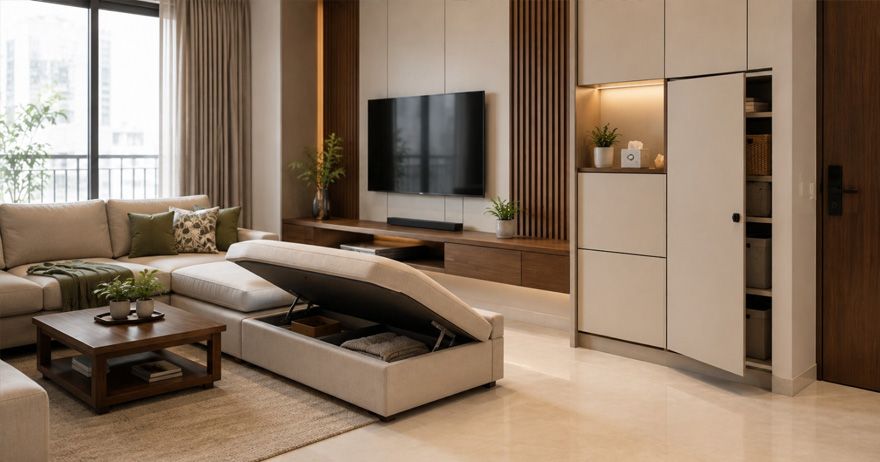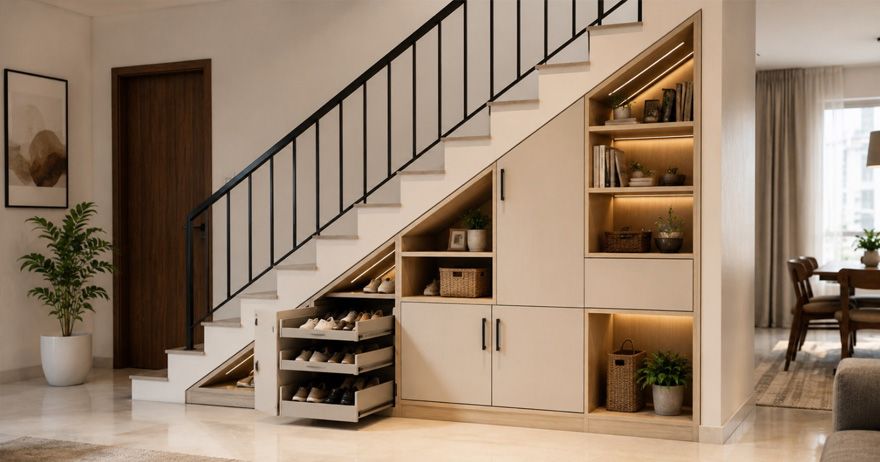




Most Indian homes don’t have the luxury of a separate laundry room. They tend to have a laundry utility balcony of 4 ft by 6 ft in which one can accommodate a washing machine at one corner, some clothes drying on a line above. A good laundry room design helps make the best out of that rather small utility space, rather than using a design used elsewhere in the world.
The three things that make or break a laundry room are- the number of plumbing points, the air circulation, and the placement of wet clothes during monsoon. Here are 20 ideas, with materials used, and things to avoid.
Why a Well-Planned Laundry Room Matters
Washing is a daily chore in most households, and with insufficient space, washing areas are pushed out into the rest of the home - with a bucket in the hallway, a drying rack in the living room, an ironing board behind a door.
Moreover, a well-planned utility room is a good idea in terms of the protection of the flat: water running down along the line of the washing machine may make damp patches on the lower part of the partition wall, and laundry needing to be dried inside the flat during the monsoon season may lead to higher levels of humidity resulting in mold development in wardrobe closets.
Small Laundry Room Design Ideas
For a corner, a kitchen alcove, or a narrow utility niche.
- Stacking the washer and dryer vertically in a column to save floor space. Just make sure to use the right stacking kit.
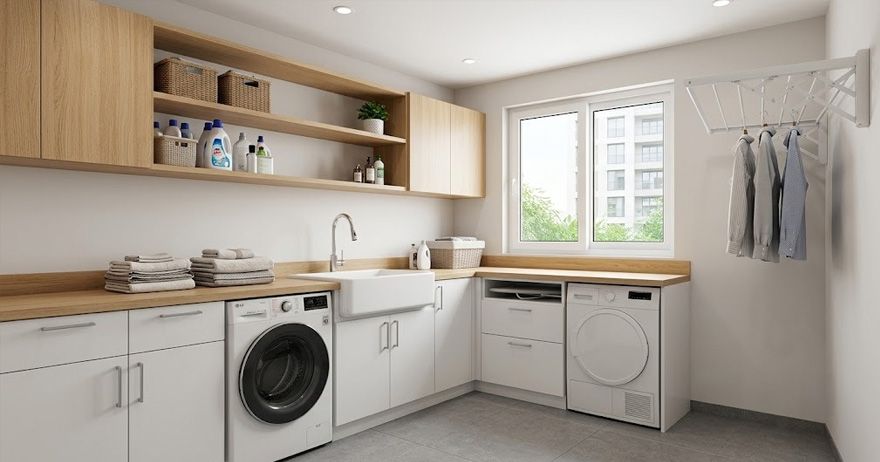
- Counter extension over a front-loader washer/dryer at 850mm, creating a work surface where there was none before.
- Pull-out basket unit mounted in a base cabinet, eliminating floor clutter.
- A folding rack mounted on the wall, opened out to use, then folded against the wall when not in use.
- Sliding or folding shutters instead of a swinging door, which saves valuable floor space.
Dedicated Utility Room Layouts
Plan a separate utility room, in a line, so that the work flows in one direction, from the sorting and washing of clothes through to drying, folding, and ironing.
- A single-wall design works well in a small utility room (up to 40 sq. ft.) allowing you to place the washer or the sink along one wall.
- An alternative to the two utility areas is an L-shaped utility room. One wall is devoted to washing, and the other to folding. This way, the dry and wet areas are separated.
- Make sure that you have a utility sink in the place where you can soak, rinse, and wash clothes, brushes, mops, and shoes.
- The under-counter space is a great place to hide a purifier and a dustbin from the kitchen.
- Finally, a dedicated ironing board with a narrow, fixed counter and a power socket at the level of the waist is a must-have to avoid having to open the ironing board every time you need to plug in the appliance.
Balcony Laundry Area Designs
The most common requirement we see in Indian flats, the one most exposed to the vagaries of our weather:
- Enclosed utility balcony with sliding windows, so the washing machine stays dry when it rains sideways in monsoon.
- Ceiling mounted pulley dryer keeping the washing area floor dry.
- Covered drying zone to protect clothes from both the rain and the bleachingly strong afternoon sun.
- Tile dado on the washing machine side wall up to height of 4 ft to prevent staining by water splash.
- Concealed shutter on the front face of the washing machine to hide the utility area from view when guests land at your door.
Do not go for fully enclosed balconies with sliding windows as air tight box, as it traps moisture inside and clothes don't get dried. Ideal solution is to have sliding windows which can be kept open on clear days while closing them during rain. Also fix a louvered ventilator to expel trapped moist air.
IndiFrame's uPVC sliding windows and ventilators are ideally suited for such applications. Unlike aluminium and wood, uPVC does not corrode/rust. The sliding window mechanism does not need any space to swing clear as they slide past each other and are good for narrow balcony spaces. Also the uPVC profiles prevent seepage of water and dust. Of course, check with your society norms first as many places do not allow such alterations on the building's facade.
Smart Storage Solutions for Laundry Rooms
- Overhead cabinets can be used for storing the detergent, softener and spare bedsheets that are kept above the splash zone.
- An open shelf provides storage space for more everyday items, and it's at a good height so that you won't have to open a cabinet at the end of the day with wet hands.
- There's a three basket rack for sorting laundry into whites, colors, and delicates.
- There's a narrow pull out next to the washing machine for storage of smaller items like brushes, hangers and clips.
- It has hooks and a rod so that you can put your clean clothes right on a hanger.
Choosing the Right Flooring and Countertops
The floor gets wet daily. Choose for grip first, looks second.
| Material | Suits laundry areas? | Notes |
|---|---|---|
| Matt anti-skid vitrified tile | Best choice | Provides good grip when wet and is easy to clean |
| Glossy vitrified tile | Avoid | Slippery when wet |
| Granite counter | Best choice | Handles water and heat well |
| Quartz counter | Good | Avoid direct contact with a hot iron |
| Laminate on MDF counter | Avoid | Edges can swell within a year when exposed to moisture |
Give it a slight fall towards the drain and ensure that the drain is not at the highest level of the balcony. This is the most common error which leads to water logging around the machine. For cabinets, BWP or marine ply, pvc board or powder coated aluminium should be used as ply tends to swell.
Ventilation and Lighting for Laundry Spaces
Airflow is what actually dries clothes. A closed room with a fan will not do it.
- Keep a cross-ventilation path, like an opening at each end of the space.
- A good idea is to install an exhaust fan, in case the room is enclosed (many monsoon-drenched Indian homes do this), plus a louvered ventilator high on the opposite wall.
- This will allow the escape of damp air even when the windows are shut against the rain.
- Moisture-proof fittings should be used, and electrical sockets positioned at least 1 ft above the work surface, away from the sink.
- Daylight is important in a utility room, because a dark wet room smells.
Many families call upon a vastu expert to decide where to put the machine, as Hindu astrology holds that it should be placed in either the north-west or the south-east of the house. If you are particularly fastidious, get this done before laying out the pipes, so that they can be routed accordingly.
Common Mistakes to Avoid in Laundry Room Design
- Cabinets need to be arranged during the planning. The machine needs to be bought first, and then cabinets need to be located around it considering its size and the swinging of its doors.
- There is no inlet or outlet as desired. There is a long pipe running on the floor.
- It is sealed, so the balcony clothes are never dry, and it is smelly.
- The dado was not done with tiles. The paint behind the washing machine will be peeled off in two years.
- Hard water in the area is not considered. In many areas, it is a common problem that water left in the machine makes the machine useless. It needs to be descaled or a water softener needs to be installed.
- Sockets should not be placed low. Sockets which are always in water are dangerous.
- Only the user is not considered. If the maid or servant is going to use the machine, it is logical to place the necessary things to be kept within her reach and not in the loft.
Latest Laundry Room Design Trends
Utility areas are being finished to a high standard, rather than left exposed. Enclosed balconies with uPVC sliding windows have become the norm. Front load washing machines are mounted underneath a continuous countertop, creating a built-in look. Matt anti-skid tiles are increasingly replacing their glossy cousins, and PVC or aluminium cabinets are making their way into wet areas, usurping their plywood predecessors. Even in homes that boast a separate dryer, ceiling pulley dryers are being installed because, while they still rely on the monsoon to put clothes on the line, life can be unpredictable during that time of year.
Final Thoughts
Good laundry room design in an Indian home is not about having a large laundry room. That’s about having a dry machine, water going where it’s supposed to go, air circulation in the place, and having a place for clothes to dry if it rains for a week. Plan the plumbing and windows before you plan the cabinets.