


What Is Smart Glass?
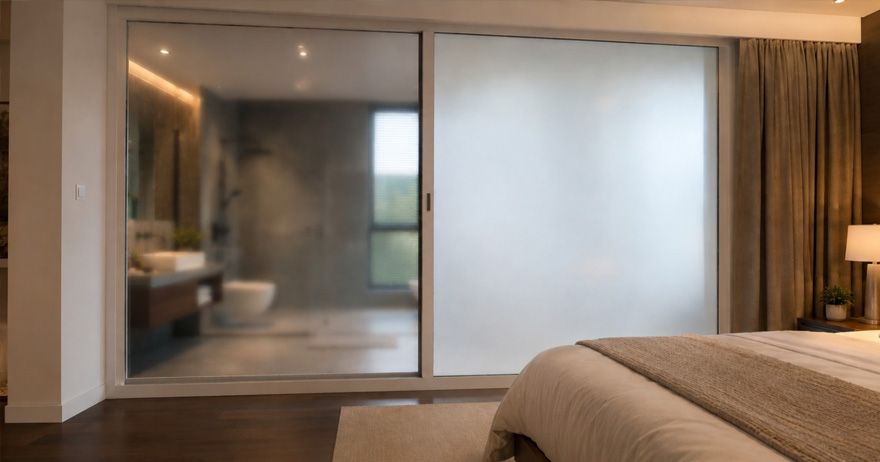
Smart glass is a type of glass that can change from clear to frosted, or the other way round, at the press of a button. It is also called switchable glass, privacy glass, electrochromic glass or PDLC smart glass. Instead of using curtains, blinds, or a permanent frosted film to block a view, you can flip a switch, and the glass turns milky white in seconds. If you flip it back, it turns transparent again. It is mostly used in offices, hospitals, cars and in homes- bathrooms, balconies, and partition walls.
But are smart glass windows worth your investment? This guide explains how smart glass works, its benefits, costs, limitations, and whether it is the right choice for your home.
How Does Switchable Privacy Glass Work?
Switchable glass uses a technology called PDLC, short form for Polymer Dispersed Liquid Crystal. A thin film containing liquid crystal droplets is placed between two layers of glass, or is stuck onto existing glass as a film.
When electricity passes through this film, the crystals line up in one direction and light passes through, so the glass looks clear. When the power is switched off, the crystals scatter in random directions and block the view, so the glass turns opaque or milky. The smart glass windows require electricity to stay clear; without power, it stays in their frosted state.
Benefits Of Smart Glass Windows
Here are some benefits of smart glass windows.
- You get privacy in seconds without pulling curtains or lowering blinds.
- Since it is glass, and not cloth, you need not worry about washing the fabric or dusting the blinds.
- You get natural light even when the glass is in the frosted state. Curtains usually block the light completely.
- Smart glass blocks a large part of UV rays, which protects furniture and flooring from fading.
- It gives the room a clean, modern look without any visible hardware.
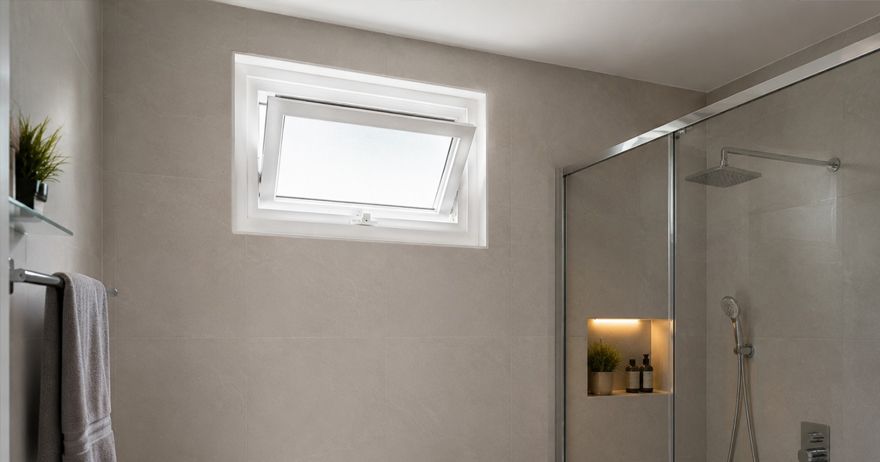
- You can use switchable glass for bathrooms, where curtains or blinds can feel bulky.
Where Are Smart Glass Windows Best Used In Homes?
In homes, smart glass windows are used where privacy is needed at certain times. Bathrooms, home office partitions, balcony doors facing neighbouring buildings, bedroom windows facing a common corridor, and pooja room doors are some good spots. Using smart glass on every window in a home is neither practical nor affordable. So, it works best in a few key areas rather than the whole house.
Smart Glass Vs Frosted Glass Vs Tinted Glass
| Feature | Smart Glass | Frosted Glass | Tinted Glass |
|---|---|---|---|
| Privacy | Full privacy on demand and switch between clear and opaque | Full privacy with permanently frosted glass | Partial privacy |
| Light control | Lets in light in both clear and frosted states | Lets in diffused light | Cuts down brightness and glare |
| Electricity requirement | Needed to stay in clear mode | No | No |
| Switch clear to opaque | Yes anytime | No and fixed | No and fixed |
| Maintenance | Wipe like regular glass and check wiring occasionally | Wipe like regular glass | Wipe like regular glass |
| Cost per sq ft | ₹800 to ₹2500 | ₹50 to ₹150 | ₹200 to ₹800 |
| Best for | Bathrooms home offices glass partitions and balconies | Areas that need privacy at all times | Areas that need heat or glare protection |
Smart Glass Price In India
In India, PDLC glass costs between INR 800 and INR 2000 per sq ft, depending on film quality, glass thickness, and brand.
A full smart glass unit, where the PDLC film is placed between two panes of toughened glass, usually costs INR 1500 to INR 2500 per sq ft.
If glass is already installed and only a retrofit is needed, a smart film on its own costs between INR 1000 and INR 1500 per sq ft. This is cheaper than replacing the whole panel.
Note that prices vary by city and installer.
Things To Consider Before Installing Smart Glass For Homes
Here are some points to consider before installing smart glass.
- Smart glass needs an uninterrupted power supply to stay clear. Without power, it turns into a frosted state. So, it is necessary to plan for backup during power cuts if the glass should stay transparent through an outage.
- Make sure to check the warranty carefully. Most established brands offer one to five years on the PDLC film, and this is one of the biggest differences between a cheap product and a reliable one.
- Get a professional to install the smart glass because you need someone experienced with wiring glass. Poor wiring can cause flickering or patchy frosting.
- Many films cannot handle constant moisture. So, ask if the film is rated for humid areas like bathrooms.
- If the film fails, the entire glass panel may need to be replaced, not just the film.
Common Myths About Smart Glass
Here are some common myths about privacy glass windows.
- There has been a rumour that smart glass works without electricity. But the truth is, it needs power to change state, and without power, it stays in its default setting, which is usually frosted.
- Another myth is that smart glass is fragile. But in reality, most units use toughened or laminated glass, which is stronger than regular glass.
- Some believe that smart glass is soundproof, but it is not. It offers no more sound insulation than regular glass of the same thickness.
- Usually, smart glass is chosen only for offices and showrooms. But they are also best suited for bathrooms, partitions, and balconies in homes.
Are Smart Windows For Homes Worth The Investment?
Smart glass windows give privacy on demand, and so, it is definitely worth the investment. It also acts as a stand-out factor when the property is sold or rented later. But instead of using smart glass throughout the house, use it where it is really needed. For everywhere else, stick to regular glass with curtains or blinds.
Final Thoughts
Smart glass benefits go on and on. So, do not think of it as a gimmick. It solves a real privacy problem in homes where curtains and blinds feel out of place, such as bathrooms, home offices, and glass partitions. So, when used in the right spots, smart glass is a one-time upgrade that pays off for years in comfort and convenience.