



Good chimney design focuses on its primary purpose – the removal of smoke rather than on aesthetics. Two chimneys of the same rating can perform completely differently based on the hood’s width, ducting routes, and fresh air intake. Get these three right, and a decent, mid-range chimney performs better than a high-end but badly installed one.
What Is a Kitchen Chimney and How Does It Work?
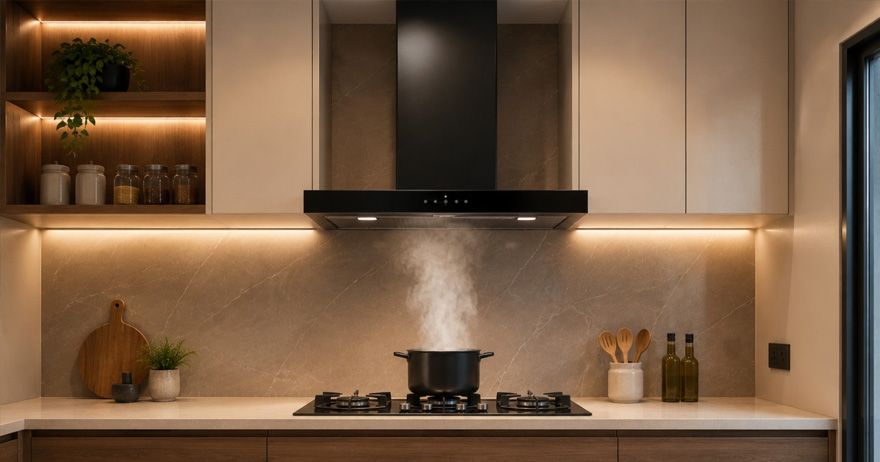
A kitchen chimney is an extraction hood mounted above the hob which captures the rising vapour, extracts away the grease, and either vents the air outside the kitchen through a duct or recirculates it after passing through a charcoal filter.
Heat forms a plume of vapour which is contained by the hood before it can escape. The extracted air is then passed through a filter (baffle, mesh, or filterless auto-clean) to remove the oil which has been atomized in the vapour. The motor then suck this filtered air out through ducts or, if the hob is ductless, through a charcoal filter and back into the room.
The effectiveness of a chimney lies in containment. Vapour which escapes to one side of the plume before being captured by the hood cannot be fully removed by any amount of suction.
Why Every Modern Kitchen Needs a Chimney
Unlike the cuisines which these were designed to combat, Indian cooking produces an unhealthy amount of airborne oil. Tadka, deep-frying and searing methods produce aerosolized grease and particulate matter which coats rangehood vents, ceiling edges and tile grout. That gummy residue on your rangehood isn't a cleaning problem, it's condensation - the burnt oil vapours being extracted. It also extracts away moisture and other byproducts of combustion, which is more important in enclosed modern apartments than it was in old-world homes with cross-ventilation.
A chimney only works on the air directly above the hob, with the rest of the kitchen's airflow being determined by the aforementioned cross-ventillation.
Different Types of Kitchen Chimney Designs
- Wall-mounted: mounted above the hob on the wall. The standard option in India for pyramid, straight-line, and curved-glass hob designs.
- Island: suspended from the ceiling above an island hob. It requires a longer duct run and has a higher suction capacity, as the plume is thrown up and is exposed on all sides.
- Built-in: hidden within cabinets, usually with only the intake visible, offers the least intrusive design but has limited space for the hood.
- Corner: for corner hob installations, the hood is mounted at an angle.
- Downdraft: built into the countertop around the hob and can be hidden when not in use, ideal for open-plan kitchens where an overhead hob would restrict vision.
In addition, filters can dictate the design. Baffle filters are used for the recirculating system; they trap the grease by forcing the air to change direction. Mesh filters become clogged quickly, while the filterless auto-clean units heat up the oil until it runs down a drain tray. Induction and brushless DC motors are common; the latter is a more energy-efficient option that produces less noise at lower speeds.
Wall-Mounted vs Island vs Built-In Chimneys
| Feature | Wall-mounted | Island | Built-in |
|---|---|---|---|
| Best for | Standard L- or U-shaped kitchens | Hob on a central island | Compact or minimal kitchens |
| Suction needed | Baseline | Highest because the plume is exposed on all sides | Baseline to high |
| Duct run | Usually shortest | Longest via the ceiling | Depends on cabinet position |
| Install cost | Lowest | Highest | Moderate and requires cabinet planning |
| Visual impact | Visible feature | Statement piece | Nearly invisible |
How to Choose the Right Kitchen Chimney
While installing the chimney, first decide on the width based on hob width – usually, a 60 cm chimney is ideal for 2-3 burners while 90 cm chimney suits 3-4 burners. The suction power of the chimney should be calculated according to the size of the kitchen – length x width x height in meters. Take at least 10 times of this number in terms of air volume to be extracted per hour. For example, if the kitchen is of 8 m2 and 3 m height, then it will require at least 1200 m3/hr.
chimneys have a range of 700-1600 m3/hr suction power. For normal cooking, you can go for 1200 m3/hr while higher ranges (1400 m3/hr and above) are suitable for open-plan kitchens, larger than average kitchens, and people who use oil for cooking regularly. The rated capacity of the chimney is measured at free air without any filters or ducts, so always go for a chimney with a capacity 2-3 times higher than the required suction power.
Most important of all, do not place the chimney lower than the recommended height (usually, 65-75 cm for gas hob). Otherwise, there are higher chances that the flame from the hob will come out and catch the chimney on fire. On the other hand, placing the chimney higher than recommended reduces its capacity to extract smoke, fumes, and odour.
Factors to Consider Before Buying a Kitchen Chimney
- Duct route: The route should be short and straight, as every bend reduces airflow. The position of the hob should be decided when taking into account the exit point of the duct.
- Make-up air: Ducting does not remove airflow from the room; rather, it draws out air, and consequently, it needs to be replaced. If the kitchen is fully enclosed, the rangehood’s motor can create negative pressure, effectively reducing its power – an openable window should then be considered as part of the extraction system. Casement windows can provide a good seal when closed and excellent extraction when opened – so consider specifying an IndiFrame uPVC system as part of the joinery package.
- Noise: Most rangehoods produce between 55–60 dB at maximum power – this is audible in an adjoining room, especially over carpet.
- Filter maintenance: Consider whether the baffle filters are likely to be cleaned on a monthly basis – if not, automatic cleaning is a feature worth paying a premium for.
- Warranty period: Coverage for the motor is more important than the warranty on the unit itself, so specify accordingly.
- Certification: Ensure that the relevant certification for the region is specified, as some imported rangehoods do not possess the mandatory safety approvals.
Common Mistakes to Avoid During Chimney Selection and Installation
- Buying Range Hoods Based Solely on Suction Rating while Disregarding Hood Width and Duct Design.
- Long Duct Runs with numerous 90 degree bends that cause a significant drop in performance.
- Using undersized ducting or reducing the size of the duct to fit an existing hole in a wall or ceiling
- Mounting the range hood too high to clear a headroom obstruction, rather than using a taller model.
- Sealing the Kitchen so that there is no provision for make-up air to enter the room.
- Installation by unqualified persons resulting in a range hood that is incapable of performing as indicated by the manufacturer.
- Mounting the cooktop in front of a window without considering the location where the ductwork will have to exit.
Maintenance Tips for Long-Lasting Performance
- Wipe the outer surface of the chimney’s hood weekly. Grease becomes harder to remove when it dries.
- Clean the baffle or mesh filters with hot soapy water every 3–4 weeks. Empty the auto-clean oil collectors once a month.
- If you have a ductless chimney, remember to replace the charcoal filters every 6–8 months. They cannot be cleaned.
- Turn on the chimney for 3–5 minutes after cooking to remove the leftover vapor.
- Get your chimney cleaned by a professional once a year. It is important to clean the ducts as well.
- If you notice that the suction is not as strong and the machine seems noisier than it should, there is likely something wrong with the filters or, maybe, the motor.
Latest Kitchen Chimney Design Trends
Kitchen chimney design trends toward quieter, more attractive products. Brushless DC motors are used for their low-noise, low-power characteristics. Filterless auto-clean is the new normal for midrange models, not an aspirational upgrade. Vertical and sloped hoods mounted close to the wall address the headroom issue of pyramid designs, and matte black finishes are displacing stainless steel in modular kitchens.
Final Thoughts
Effective kitchen chimney design primarily considers a hood large enough to encompass the plume, suction appropriate to the room’s volume, short duct runs with minimal bends, proper installation height, and adequate replacement air for the motors. It’s good to have extras, but these basics are critical.
Define the lay of the ducts and the room’s ventilation in relation to the cabinetry. Re-working the duct routing after the modular cabinets have been installed is prohibitively expensive and typically ineffective.