



The most cost-effective way to make a room feel bigger is to not buy new tiny furniture. The small living room decor hacks that make the most difference are about light, sight lines and square footage.
Most advice will tell you to start with your sofa. Forget that- start at the window and work inward.
Why Smart Decorating Matters in Small Living Rooms
A small living room is usually anything under 150 sq ft – the main living area in most 2BHK flats across Hyderabad, Bengaluru, Pune and Mumbai. Carpet areas have decreased while the demands on that one room have increased – it has become the drawing room, dining space, work-from-home office and the guest room during special events.
In a large room, a wrong choice is less damaging while in a smaller space, everything is magnified; a couch that is 100mm too deep reduces the throw distance for your balcony by 300mm. It is better to measure twice than to guess once.
Choose Multi-Functional Furniture
Pick pieces that do two jobs and leave the floor visible underneath. A sofa on raised legs reads lighter than an identical one sitting flush, despite the same footprint.
| Instead of | Try this | Why it works |
|---|---|---|
| 3-seater with rolled arms | 2.5-seater with slim arms and raised legs | Recovers 150–200 mm of space and shows more floor |
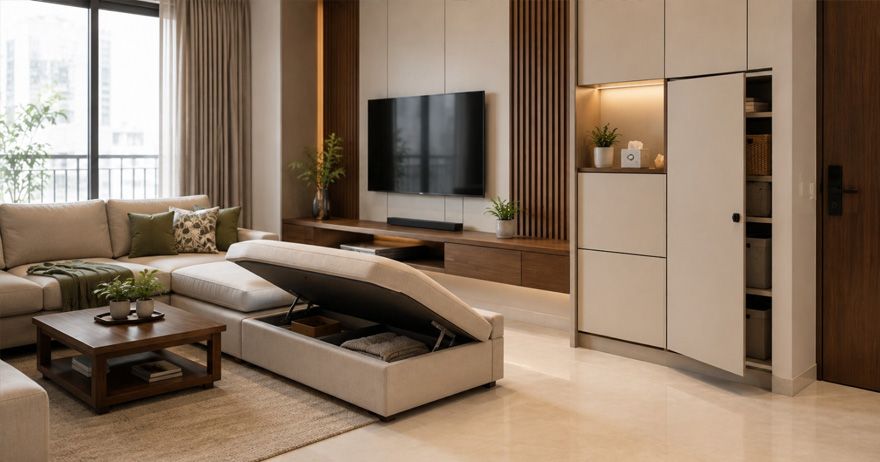
| Heavy centre table | Nesting tables or a storage ottoman | Slides aside easily and doubles as seating |
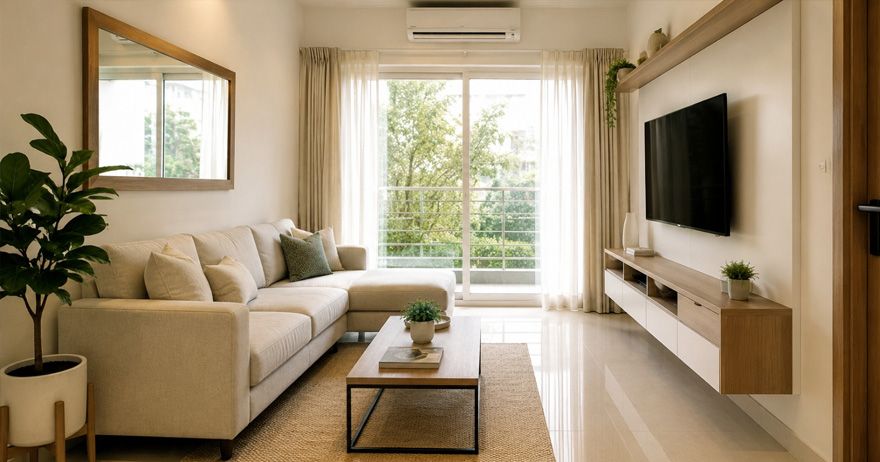
| Floor-standing TV unit | Wall-mounted console | Keeps the skirting visible and creates a lighter appearance |
| Two accent chairs | Stools that tuck under the console | Provides guest seating without taking up permanent floor space |
| Full-wall shelving | One tall narrow 400 mm-deep unit | Provides storage without overwhelming the wall |
Three numbers to remember: sofa depth 800–850mm, 900mm of clear walkway, and never buy a recliner without measuring it reclined.
Use Light Colours to Create an Open Feel
Light walls reflect more light, while also de-emphasizing the meeting point of the two surfaces. A less clear demarcation makes the room appear taller than it is. Similarly, useful is the tonal continuity throughout the room: the same applies to off-white walls and ivory curtains, warm grey and stone grey drapes. Contrasts kill a room; continuity lets it flow beyond its architectural boundaries.
- Sheen is as important as colour: matte absorbs light, while eggshell or satin reflects it.
- Always paint the ceiling lighter than the walls, but never darker.
- The contrast should be reserved for objects: cushions, a rug border, or one statement picture. Dark details in rooms are always desirable, but dark objects overwhelm the space.
Maximize Natural Light with Large Windows
This is where small living rooms miss out on maximum yield the most. You can paint a room in a weekend, but daylight is structural.
It’s the glass area that buys you light, not the window size. Two windows in the same opening will produce varying yields depending on how much frame is intruding on the glass. Older aluminium or wooden systems sacrifice glass area for slim sightlines, while uPVC allows you to keep more glass in the same space – the difference between a well-lit room and a need for lights at 4pm.
The opening style also determines the window’s footprint competition for both floor and wall space:
| Window style | Behaviour in a compact room | Best suited to |
|---|---|---|
| Sliding | Sashes glide within the frame without swinging inward | Walls with a sofa or console beneath |
| Casement | Opens fully and seals tightly when closed | Rooms facing traffic noise or dust |
| Bay window | Projects outward and adds depth without increasing carpet area | Reading nooks and spaces that benefit from light from three sides |
| Fixed with top-hung vent | Large pane with a minimal frame | View-facing walls |
A bay window can provide value to a small home as it protrudes outwards from the structure increasing the floorplan volume with space previously not there plus allowing a useful ledge for seating. The curtain rod should be mounted as high as possible on the wall and extended beyond the reveal by 200-300 mm so that drapes will fall to the wall rather than across glass. Pay attention to the frame color when shopping as white and light laminates will recede while dark frames will add an imposing rectangular shape to the room.
For windows facing a main road, glazing should be upgraded at the same time with larger sheets of glass as there is no point in deadening airborne sound without extra glass area to compensate. IndiFrame’s uPVC systems offer sliding, casement and bay options with a choice of 5 mm to 20 mm glazing plus DGU.
Add Mirrors to Make the Room Look Bigger
Yes, but placement is everything. A mirror does not create space but simply reflects what is in front of it. So, if the mirror is facing a window showing you the view beyond, it will make the room appear larger. However, if the mirror is facing your cluttered bookcase, it will only reflect the mess.
A single, large mirror placed on the wall next to your main window facing the mirror will allow you to have an abundance of natural light coming into the room from the sides. If possible, place a full-length mirror leaning on the wall to reflect the floor since the one you see would be duplicated.
Use Vertical Storage and Floating Shelves
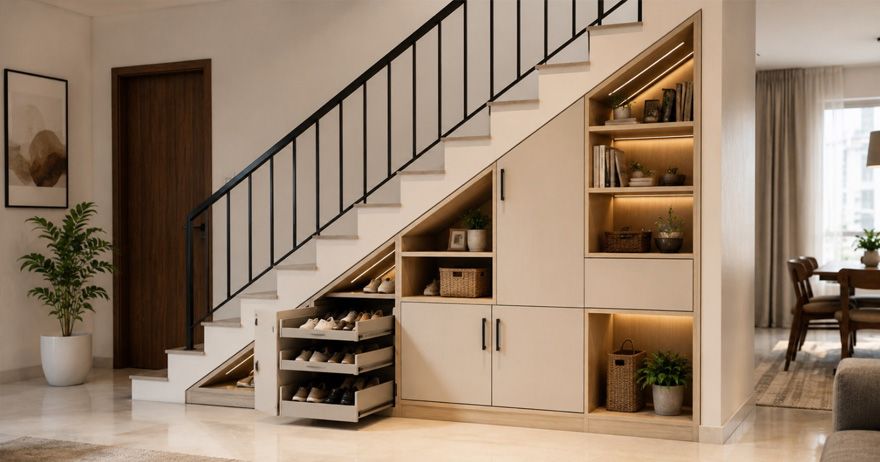
When the floor space is limited but overhead space is available, build wall-mounted storage. This ensures that the skirting boards are still visible. The uninterrupted floor plane also helps trick the eye into believing that the room is larger than it actually is.
- Make sure your floating shelves are shallow, no deeper than 25-30 cm.
- Storage that is closed and low, open and high – every day things have their place on the lower shelf within eye reach while the cluttered spaces are hidden behind the closed cabinet doors above.
- A storage compartment built into the window-seat with a hinged lid is perfect for stashing away smaller items.
Create a Focal Point Without Overcrowding
Every room needs a focal point, but smaller rooms need just one. Gallery walls, an oversized rug plus a giant light, or something else can make the room feel cluttered. The easiest way to create a focal point is to use whatever window you have as the center of your room; keep the rest of the wall simple. If you have room for a gallery wall, go with one piece of art that's twice as long as your sofa, not a dozen assorted frames.
Choose the Right Lighting for Small Spaces
Layered lighting is formed by three components: ambient (background) lighting, task (reading) lighting, and accent (spot) lighting. One overhead light fixture in the center of the room is the most common but least desirable lighting scheme in Indian homes. It creates shadows on the walls and makes the room feel boxy.
- Add a wall-mounted sconce or a floor lamp to a corner to throw light into the shadowed areas.
- Go for warm white color temperature (2700K-3000K). Cool white is suitable only for kitchens
- Use cove lighting to create the illusion of a higher ceiling by putting the fixture along one edge of the ceiling.
- Accent lighting should throw light on an area, such as a reading nook, an artwork, or a potted plant, or even a corner. An unlit corner tends to make a room feel smaller, while an accented corner makes it appear larger.
Common Decorating Mistakes to Avoid
- Pushed every piece flush against the walls. The front legs of your seating are going to be sitting on the 100mm or so that you have pulled the sofa forward.
- Too small a rug - the front legs of your seating should be sitting on it
- Heavy dark curtains drawn even when the glass is open.
- Tall unit to one side of the window blocking any light coming in at an angle.
- Looking out is a distraction, a rusty grill stops your view out through the glass.
- You got the wrong size in the walkway, doorway and lift as a result of shopping too soon.
Final Thoughts on Small Living Room Decorating Ideas
The best small living room decorating ideas are not about having fewer things. They’re about thoughtfully considering where to place the light, sightlines, and floor visibility so that everything else can complement and lead into them.
Make sure you do things in the right order: windows/lighting before paint before furniture before styling and decor. Get it wrong and you’ll end up with a beautifully furnished room that looks like twilight at three in the afternoon.